 EN

- Overview
- Recommended Products
Overview
Filling range of 30–500 mL
Maximum production speed of up to 40 bottles/min, subject to product testing
316L stainless steel filling pumps, cylinders and filling heads
Adjustable servo capping torque
Storage for up to 20 production recipes
Load empty bottles
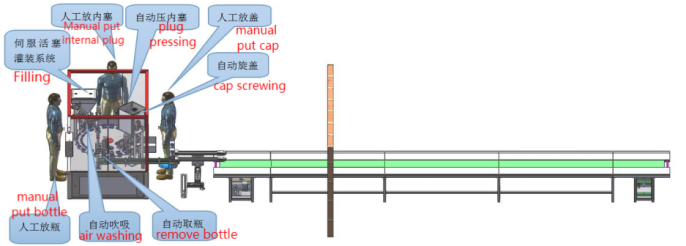
Operators place bottles into the adjustable holders. The rotary mechanism moves them through the processing stations.Detect bottle presence
Bottle detection controls the process. Filling, pressing and capping are inhibited when a bottle is absent.Fill the containers
Positive displacement pumps meter the product into the bottles. Filling speed can be adjusted to suit the material, while diving filling helps reduce foam formation.Place and press inner plugs
Operators position the inner plugs. The pneumatic pressing mechanism seats them in the bottles.Place and tighten outer caps
Operators place the outer caps. The capping mechanism grips and tightens them using servo-controlled torque.Unload finished bottles
A pneumatic gripper transfers finished bottles to the discharge conveyor for the next packaging stage.Labeling Machines
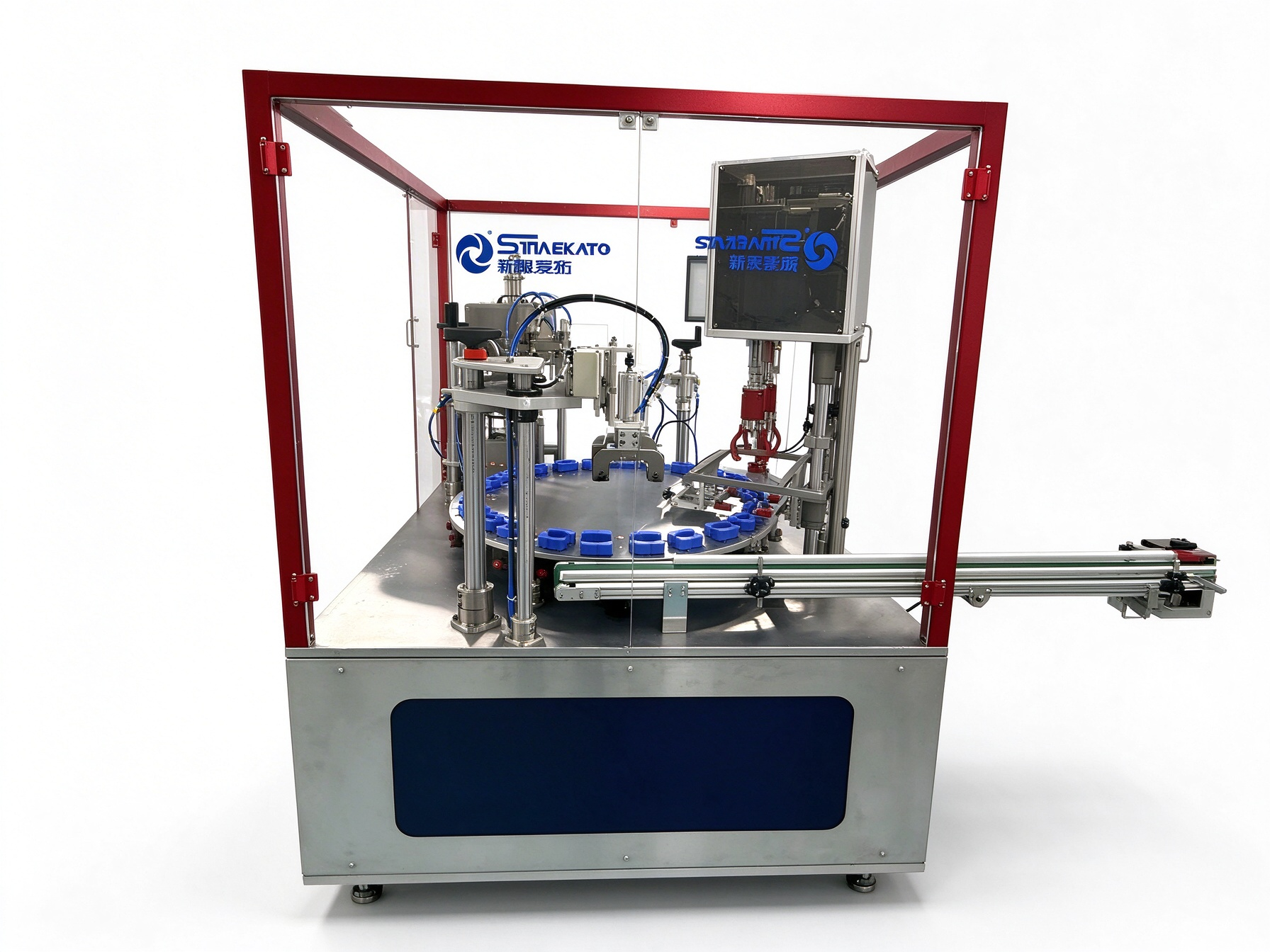
SFR-400 Rotary Filling and Capping Machine
01 · PRODUCT HERO
Servo Filling and Torque-Controlled Capping for Bottled Cosmetics
The SFR-400 combines filling, inner plug pressing, servo capping and finished-bottle unloading on a rotary platform. Adjustable bottle holders, saved production settings and a removable filling cart support routine product changeovers.
Discuss Your Requirements
02 · PRODUCT OVERVIEW
Coordinate Filling and Closure Operations on One Rotary Platform
The SFR-400 is designed for bottled cosmetic products requiring controlled dispensing and cap tightening. Operators load empty bottles and place inner plugs and outer caps manually. The rotary mechanism transfers bottles through the filling, pressing, capping and unloading stations.
Servo-controlled filling allows the dispensing speed to be adjusted for different materials. Diving filling introduces product closer to the bottom of the container to help reduce foam formation.
The filling assembly uses a removable cart with quick-release connections, making it easier to remove product-contact components for cleaning. Adjustable bottle holders accommodate different bottle sizes within the machine’s supported dimensions.
A Mitsubishi PLC and colour touchscreen provide operation control. Saved production recipes help operators recall settings when returning to a previously configured product.
03 · TECHNICAL SPECIFICATIONS
SFR-400 Technical Data
| Parameter | Specification |
|---|---|
| Model | SFR-400 |
| Machine type | Rotary filling and capping machine |
| Filling range | 30–500 mL |
| Maximum production speed | Up to 40 bottles/min |
| Applicable bottle diameter | 28–80 mm |
| Applicable bottle height | 90–200 mm |
| Standard power supply | 220 V, 50 Hz, single-phase |
| Filling pump quantity | 2 |
| Filling cylinder quantity | 2 |
| Filling head quantity | 2 cutting-type filling heads |
| Filling pump, cylinder and head material | 316L stainless steel |
| Structure material | 304 stainless steel |
| PLC | Mitsubishi |
| Operator interface | Colour HMI |
| Frequency converter | Mitsubishi |
| Pneumatic components | FESTO or SMC |
| Saved production recipes | Up to 20 |
| Capping control | Servo-driven, adjustable torque |
| Empty bottle loading | Manual |
| Inner plug and outer cap placement | Manual |
| Finished-bottle unloading | Automatic |
Actual production speed depends on the material, filling volume and container characteristics, and must be confirmed through testing.
04 · WORKING PRINCIPLE
From Empty Bottle Loading to Finished-Bottle Discharge
05 · APPLICATIONS
Bottled Cosmetic Products
The SFR-400 supports cosmetic filling projects using containers within its specified dimensional range.
Typical project requirements include controlled filling, inner plug insertion, screw-cap tightening and repeated changeovers between bottle formats.
Suitability should be assessed using the actual formulation, target filling volume, bottle and closure samples. Product flow, foaming behaviour and closure design influence the required settings and achievable output.
Discuss Your Product and Packaging
06 · CUSTOMIZATION & SERVICE
Configure the Machine Around Your Packaging
Adjustable bottle holders, pressing height and capping torque allow the machine to be configured for different compatible bottle and closure formats.
For configuration review, provide your material information, target filling volume, bottle dimensions, closure samples, required output and site power supply. Electrical requirements other than the standard 220 V, 50 Hz, single-phase supply should be specified in advance.
The removable filling cart and quick-release connections provide access to the filling components for disassembly and cleaning.
The equipment warranty is one year from the date of delivery.
07 · FAQ & RELATED PRODUCTS
Frequently Asked Questions
Is bottle loading automatic?
Empty bottles are loaded manually into the holders. The rotary mechanism then transfers them through the processing stations.
Are inner plugs and outer caps placed automatically?
Inner plugs and outer caps are placed manually. The machine performs plug pressing and servo cap tightening.
Can the machine reach 40 bottles per minute with every product?
The specified maximum speed is up to 40 bottles/min. Actual output depends on the material, filling volume and container characteristics, and is confirmed through testing.
Can the machine handle different bottle sizes?
The specified bottle range is 28–80 mm in diameter and 90–200 mm in height. The holders are adjustable. Compatibility with each bottle shape and closure should be checked using samples.
Can production settings be saved?
The PLC can store up to 20 production recipes for recalling previously configured settings.
How are the filling components cleaned?
The filling assembly uses a removable cart and quick-release connections, allowing components to be removed for cleaning.
What happens if a bottle is missing?
Bottle detection inhibits filling, pressing and capping when no bottle is present.